


Pedals, Perseverance & Prayer Flags (and Occasional Profanities)

Updated: Nov 19, 2025
Notes from high altitude, cycling the Western Himalayas in June / July 2025.

In July, I returned from what is likely to remain a highlight of my life on this weathered old planet for as long as I live. Already a seasoned India traveler (albeit mostly in the south), and a decade-long cyclist, I spent two weeks exploring the Western Himalayas, between Manali (HP) and Leh (Ladakh) in early-summertime, 11 of those days by bicycle. Organised by Mike and the team at Mountain Bike Kerala, the tour began with a slow 3-day acclimatisation as we traveled by train and minibus from Delhi to Manali, which sits at an elevation of around 2000 metres. We then assembled the bikes, swapped the minibus for two pick-ups (our support vehicles), tied prayer flags to our handlebars, and set off to test our physical and mental stamina for the remaining 12 days. This was set to be a trip of extremes, one that pushed the body and mind to their limits, while the eyes took in otherworldly landscapes; the scale, colours, and sheer beauty of which one could never imagine. For anyone keen to undertake such a challenge at high altitude, or for those who already have and would like to reminisce about the pleasure and pain, here’s a few notes I compiled along the way, often at 1am when I woke up, mind fully alert, thinking it was time to get on the bike again!

Training
I was aware of the elevation and climb profiles of the 11 rides in advance, and decided I would need to be comfortable with climbing more than 2000 metres in a day. From January to early-May I tried to do two big rides per week, (between 1000m and 2000m total climb), culminating in a self-devised ‘three peak challenge’ that saw me climb a total of 3800 metres in a day, with the last peak being Fethiye’s highest mountain, Cal Dağı, at 2200 metres elevation. I definitely felt the effects of altitude and energy depletion during the final kilometre of that climb.
In the last month of training at home, I switched to a few shorter, consecutive days in the saddle to get my bum used to being on the bike every day (or at least prepare me for the discomfort!).
I arrived in India two weeks before the big Himalayan adventure to catch up with friends in the south (I lived and worked in Kochi, Kerala in 2011/2012), and luckily was able to include a short trip to Mountain Bike Kerala HQ in the foothills of the Western Ghats, to get out for a few warm-up rides in between the monsoon downpours. The week before the big trip I did two gym sessions combining weight training and spinning. I was fairly confident in my physical ability to complete the rides according to the climb profiles, but I was entering the total unknown of endurance activities at high altitude, and was only armed with horror stories of altitude sickness that I’d gleaned online. I have been overweight all my life, and therefore had convinced myself I would suffer more as my blood oxygen levels dropped. Turns out I was wrong! In fact, there’s a good chance my fat stores came in handy for fuel.

Rules of Cycling at High Altitude
Rule number one: Forget everything you know about cycling
The Rohtang Pass near Manali was the 3rd ride of the tour with a total climb just shy of 2000m, and the first toe-dip into high elevation (3000+ metres). The ride saw us reach an altitude of just under 4000m before dropping back down to Sissu at 3100m. Knowing we had 9 more rides ahead of us, with just one rest day near the end, I honed the turtle technique, starting off the ride embarrassingly slow, adopting a super-relaxed pace and avoiding getting out of breath as much as possible. I was basically giving such little effort to pedal pushing that I felt as though I was almost balancing on the bike and giving (what it felt like to my fully-trained climbing legs) absolute minimal effort. I started to suspect I would actually lose muscle mass in my quads during the 2-week Himalaya adventure, ‘detraining’ as Mike termed it! For the remaining ‘tough days’ (they were all tough!) cycling became a sport of balance, rhythm, breath-control and mindfulness, and I was definitely rewarded with moments of euphoria as the oxygen got thinner.

Rule number two: Remember, some climbs are steeper than others
My preconceptions of the Himalayan highways being as steep as the other mountain roads I have encountered in my cycling life were shattered on the Rohtang. It turned out all the mountain passes in Himachal Pradesh and Ladakh have been carved at very friendly gradients! Our 1st ride was a warm-up out-and-in up to the Hampta Pass near Manali (and back down again, weeeeeeee) and was probably, overall, the steepest climbing we did.
I guess for training purposes I’m lucky to live in an area with juicy climbs in almost every direction (basically anywhere but the sea), as the 6 months of climbing I did in preparation for this tour definitely stood me in good stead, though pressure from pedal pushing on climb-heavy rides has left me with an overuse injury to my right foot (inflammation at the 5th metatarsal). It’s time to switch to cleats, I guess.
Rule number three: Remember, no trees, no shade
Another preconception I had was that I would find the landscapes less visually pleasing above the treeline. Actually the scenery was equally gorgeous when rock replaced green, but I stupidly hadn’t equated no trees to no shade. I had presumed the heat would be far from intolerable above 3000 metres, however on the day we climbed the Gata Loops, plus a few sections of other rides, I became very hot and incredibly frustrated by the lack of respite from the sun. I resorted to jumping in the van (stationary) for ten minutes a couple of KMs above the Gata Loops to have a break from the harsh sunlight and heat, and spent the next hour dreaming up prototypes of clip-on retractable helmet parasols.

Rule number 4: Don’t hold your breath!
The surprising things that we unwittingly hold our breath while doing, come to light at high altitude. These include:
Smiling for a photo (selfies especially get you huffing and puffing!)
Putting on trousers (I learnt this during 3 + changes of clothes on the very wet Rhotang ride)
Brushing your teeth (obvious)
Turning in bed
And finally, I had to train myself not to gulp down water. A technique of one gulp to 3 breaths is required at high altitude, otherwise you’re panting like you’ve just done 20 burpees!

Rule 5: Eat less in the evenings
I had been warned about sleeping being tricky once we were overnighting at 4000+m, and our first night at such altitude, Sarchu (4200m), did not disappoint. Now, I did make a fatal error in eating a lot of dinner and going almost immediately to bed. From 9pm to 1am I felt as though I was partly-suffocating, I was really working my diaphragm hard to take in enough air and my resting heart rate was up to 93 (it had been around 73 the previous few nights, and is usually around 58 at sea level). In hindsight, I should have done two things:
Not eaten a huge dinner and gone straight to bed, my body was having to simultaneously deal with the effects of high elevation and digestion
Propped myself up in bed with some pillows or a blanket
Following this initiation I seemed to naturally lose my appetite, and for the following few days I ate around 50% less each meal. I also tried to eat around an hour earlier in the evening, and go for a short walk after dinner. I didn’t have any major problems sleeping the next few nights, apart from waking for an hour or so in the middle of the night, then managing to get a few more hours sleep in before dawn.


Rule 6: Enjoy the head-squeeze!
I fear I got a little bit addicted to the natural highs over 4000 metres. In fact, I’ve had moments since returning home that I’ve contemplated doing the tour all over again just to see if I can relive the highs. Yep, that’s an addiction brewing!
There was a section of the Taglang La somewhere between the wake-up line (around 10kms in) and the suffer-line (around 5km from the top) where I had a lovely hour-or-so of feeling all high and euphoric. The weather was perfect (sunny but not too hot), good tunes playing from my phone, only occasional vehicles passing, focused solely on my breathing and enjoying the sensation of head-squeeze. I wouldn’t quite call it a headache, just a noticeable sensation of pressure. Deepak (MTB Kerala guide) told me to ‘just think of nothing’ and in fact you naturally do begin to think of nothing. Until things get tough, that is, and then you adopt the mantra of ‘what the f*%k am I doing?’.

Thanks goes to…
The humble highway dhaba, keeping travellers alive since the roads were carved!
Dhabas, the no-frills Indian truck-stops, became (for the non-religious among us) our temple. A place of solace when our bodies had grown weary and weather conditions brought distress. A place where we could change clothes, collect our thoughts, and pray for a brighter (or cloudier, or flatter) future. Usually food options are limited to a range of basic salty starches in the form of Maggi instant noodles, rice and dal, and occasionally parathas (flat breads). Dhabas range in architectural form. The more upmarket dhaba is built with bricks and mortar, but hodgepodge shacks, tents, and (my favourite) yurts still make regular appearances.
Most highway dhabas feature either communal sleeping platforms, or single beds lining the inner perimeter of the structure. For the adventure cyclist who is part-way through the most intense period of prolonged physical exertion of their lifetime, sleeping platforms give opportunity to lie out long, stretch and question your life choices. For the domestic tourists who have driven from low elevation to over 5000+ metres in a couple of hours, staggering into a dhaba and collapsing down on a platform means you can eradicate the risk of vomiting in your own vehicle, get local advice on the prognosis and remedies for altitude sickness, and be presented with a handful of cloves or garlic to chew on. And of course, they too can question their life choices.
Some Ladakh dhabas also deal in chhaang, a homebrew so good they gave it superfluous letters. Made with fermented barley or rice grains, chhaang is a milky-white relative of beer, with a mildness that came as a shock to my rakı-trained palate. The chhaang we purchased was decanted from what looked like a fuel can hidden under a table cloth, and subsequently consumed in a yurt next to Tsokar salt lake. Makes a difference from drinking rakı on the Mediterranean / Aegean coast!

The BRO Road Signs & all the other human-made sensory delights that decorate the Himalayan highways
Anyone who has traveled the Himalaya border area will be well acquainted with the BRO (Borders’ Road Organisation) road signs. These short rhymes are intended to be a lighthearted way of making drivers more considerate of their actions. For cyclists, they simply give an excuse to stop for a break, disguised as a photo-taking exercise.

Other things that either delighted or disgusted the senses along the way include:
Horns. What would 2 weeks on the road in India be without the famed Indian horn obsession? Musical truck horns reigned superior, my favourite being the truck that played a melody almost all the audible way up the Taglang La. In contrast, I would immediately envisage punching the face of drivers who thought it wise to give an eardrum-piercing toot from right beside me.
Dhabas. As before…. Long Live The Dhaba!
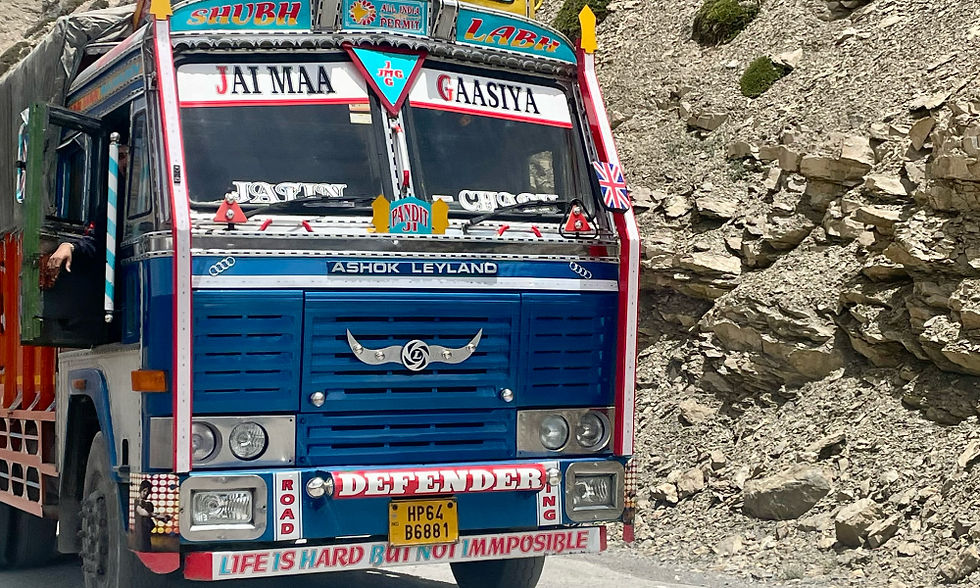
Trucks. I think India is the undisputed global king of truck design. Motivational bumper mottos beat the BRO road signs hands down!
Encouragement: Shrieks of encouragement came from people, young and old, in cars, and we got regular cool thumbs and salutes up from the hundreds of motorcyclists that passed us, usually in very long convoys. That's a lot of thumb upping for a lone cyclist! And to those who were too busy hanging out of car or bus windows vomiting due to altitude sickness to pay us any attention, I have one word for you… ‘acclimatise’ :-)
And finally a nod of appreciation goes out to the hundreds of BRO road workers we passed, usually in teams of around ten, slogging it away in the harsh sun, chipping away at rock face and filling potholes using only rudimentary tools. Both men and women take on this role, although their gender is sometimes ambiguous due to their heads and mouths being totally wrapped with scarves, in a hot bid to protect themselves from the sun. Why can’t tents can’t be erected over work sites? Having an awareness of one’s privilege makes the contrast of circumstance in this scenario slightly guilt rendering. Here I am, with the luxury of enough money to fund such a hobby, and enough spare time to be able to train consistently for 6 months to prepare for a trip that sees me electively push my body to the limits in conditions that the people I’m cycling past face almost every day. Out of necessity, not choice. And for survival, not fun. Actually, as I write this I recall there were moments of the trip when I had definitely moved out of the ‘fun’ zone and into the ‘survival’ zone, and I did seriously question why I had chosen to do this. So, to all the BRO workers who spend most of their time at high altitude, physically exerting themselves, often in harsh weather conditions, keeping the road surface maintained… helmets off to you.


Post-trip stats, observations and sadness
Total number of rides: 11
Total distance: 738 km
Total Climbing: 14,356 metres
Passes completed (with max elevations):
Hampta La (2800m)
Rohtang La (3973m)
Baralacha (4930m)
Neekla (4730m)
Lachungla (5060m)
Taglangla (5333m)
Khardung La (5350m)
Body weight lost: 4kg
Areas of discomfort: Right foot at 5th metatarsal (this overuse injury started in May and an x-ray upon return showed inflammation around the joint), chapped lips, very stiff neck (presume from a combination of cycling posture and heavy breathing)

Super-fit for 7 days: I would say the feeling of super-fitness once returning from high altitude training lasts around 7 days. Part of me wishes I had tested my cardiovascular capabilities a bit more seriously upon my return (perhaps borrowed a road bike and blasted a few classic segments near home), but my foot injury, plus the fact I returned home to 35+ degrees temps means I have decided to take it easy cycling-wise until autumn (that had been my plan all along anyway).
Cycling with the other cycle: For those who, like me, religiously track their menstrual cycle, plan training accordingly, and do celebratory dances when 3 months ahead of a sporting challenge we realise we will not be premenstrual or menstruating (see boys, you have none of this to think about)… as of writing this paragraph, around a week after returning, I am currently experiencing THE heaviest period of my life. In fact, I am purposely eating red meat tonight to boost my iron levels. Unsurprisingly, I can find no solid research as to how sports at high altitude affects menstruation, whether it’s due to the effects of high elevation on red blood cell production, or general stress on the body. I’ll confess, I’ve always thought that friends who complained about bleeding heavily were in some way exaggerating, so I’m seeing this as a grounding life-lesson and resolve to be a more empathetic sister in the future.
Climate change: Finally, a big geçmiş olsun (get well soon) to Mandi, Manali, Kullu and all the other places we passed through in Himachal Pradesh which have since been battered by unbelievable rainfall, causing numerous flash floods and landslides. We left Manali by minibus on the 23rd of June and two days later a cloudburst caused flash flooding that submerged parts of town and killed three people. Since then the region has been continuously hit by monsoon cloudbursts that have caused many fatalities (almost 200 as I complete this article on 8th August) and widespread destruction to properties and infrastructure. A combination of climate change, unplanned development, poorly planned road construction, and in some cases, poor forest maintenance is to blame (logs literally washed out of forests which then blocked waterways). Many parts of the highway we cycled have since been totally washed away.
I guess the BRO road workers have got a lot more work on their plates once the monsoon has ended....

For more info about the road tours & single track adventures offered by Mike and the team at Mountain Bike Kerala, check out their website: https://mountainbikekerala.com


A most interesting and fabulous detailed travelogue Leyla written with great attention to every aspect of this momentous achievement. Not only are you an amazing cyclist but a great writer too. Congratulations - Valerie Forshaw